Storage tank bottom corrosion: how to protect it with VCI
2 min readRoyal Integrity technical team
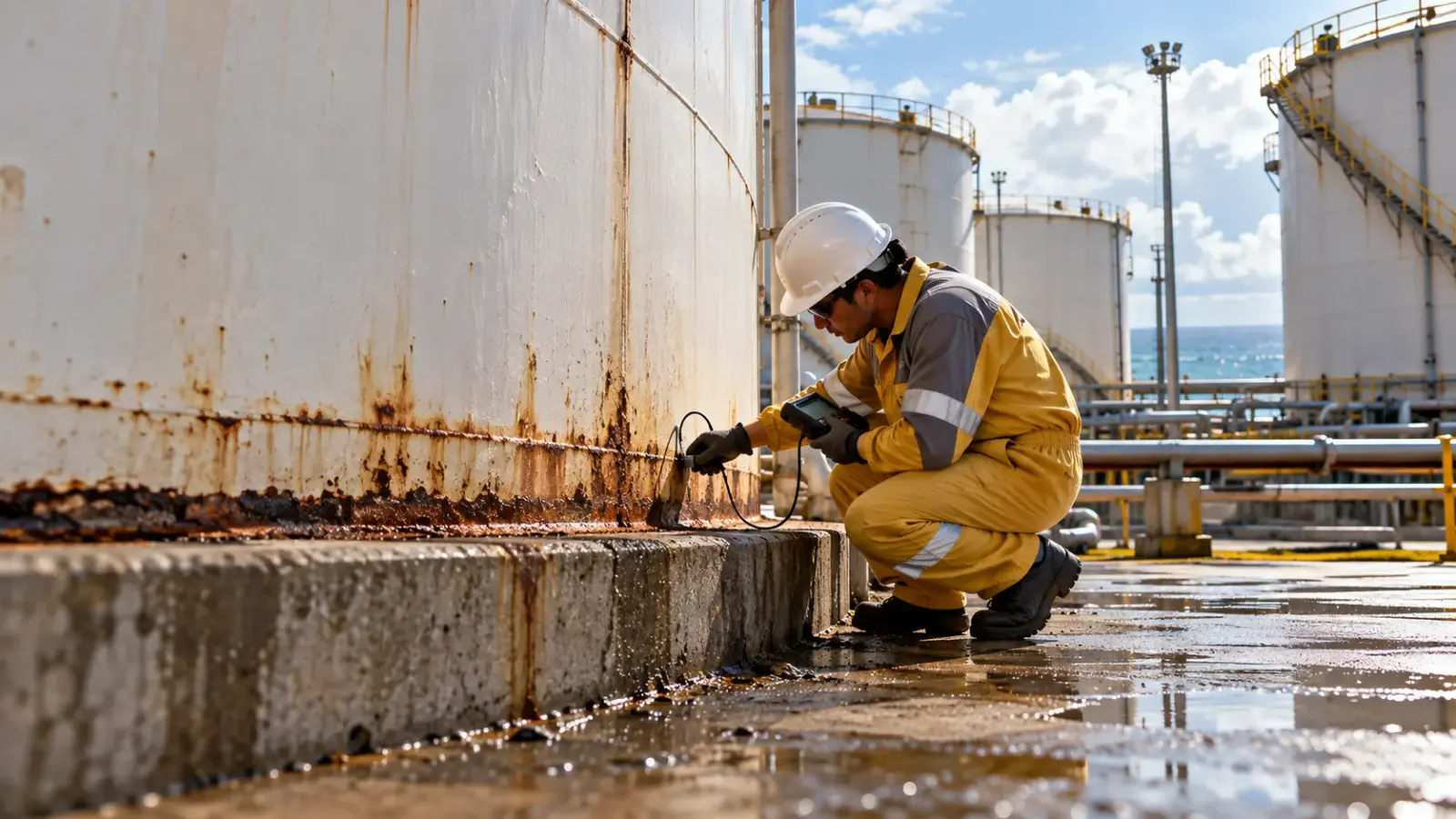
At terminals, refineries and pump stations, the hardest part of a tank to protect is the one nobody sees: the underside of the bottom plates, resting on the foundation. There, moisture, salts and soil attack the steel while neither internal paint nor visual inspection can do anything about it. When corrosion perforates the plate, product seeps into the ground.
Why the tank bottom is so vulnerable
- Inaccessible: it cannot be painted or visually inspected from below.
- Trapped moisture: rain, the water table and condensation accumulate under the tank.
- Contaminated foundation: sands with salts or chlorides accelerate corrosion.
- Limited cathodic protection: when contact between the bottom and the foundation is uneven, the current does not reach every area.
The consequences
A bottom leak means taking the tank out of service, cleaning it, repairing or replacing plates and, sometimes, remediating contaminated soil. That is weeks of lost capacity plus environmental and regulatory costs.
How VCI protection works
Volatile corrosion inhibitors are injected into the space between the tank bottom and the foundation. The inhibitor spreads through that space and forms a protective molecular layer on the steel, reaching where cathodic protection cannot. Zerust Integrity Solutions offers this technology as a cost-effective way to mitigate bottom corrosion in tanks that are in service or out of service.
Advantages
- In many cases it is applied without emptying the tank.
- It complements existing cathodic protection.
- It reduces the corrosion rate and extends the interval between internal inspections.
- It is compatible with integrity programs based on API 653.
Royal Integrity’s experience
Royal Integrity received international recognition, from Petrobras and NACE 2012, for corrosion solutions applied to flanges and storage tanks. As a distributor of Zerust – Excor, it designs and implements VCI protection for tank bottoms with technical support and follow-up.
Frequently asked questions
Does VCI replace cathodic protection? No, it complements it in the areas the current does not reach.
Does the tank have to be taken out of service? It depends on the design of the injection system; in many cases it can be applied in service.
How do you verify that it works? With corrosion monitoring in the under-bottom space and the inspections of the integrity program.
Do your tanks have a history of bottom leaks? Schedule a technical consultation.


